How to Verify a Board-Certified Plastic Surgeon in Korea
Check a board-certified plastic surgeon in Korea in minutes: KSPRS directory, HIRA, signage rules, and the 2026 changes. Step-by-step, free, no agent needed.
To confirm a board-certified plastic surgeon in Korea, look up the operating surgeon's Korean name in the Korean Society of Plastic and Reconstructive Surgeons (KSPRS) directory. Then cross-check it against the plastic surgeons' association list and the clinic's page on the national insurance review agency. Check the person who will actually operate on you, not just the clinic's name on the door.
Finding a board-certified plastic surgeon in Korea takes more effort than it should, because Korean law doesn't reserve cosmetic surgery for specialists. Anyone with a medical licence can do it.
What "board-certified" actually means in Korea
The Korean term is jeonmunui (전문의), a specialist doctor. For plastic surgery it's seonghyeong oegwa jeonmunui (성형외과 전문의). It's a legal status, not a membership badge.
Article 77 of the Medical Service Act says a doctor who wants to become a specialist must complete the training set by presidential decree and be recognised by the Minister of Health and Welfare. It also says nobody else may display a specialty. The training rules fix residency at one year of internship plus four years of residency for most specialties, and plastic surgery follows that pattern.
After training, candidates sit a two-stage national exam. A pass means scoring at least 60 percent of the total on each stage. The exam covers 25 specialties, and plastic surgery is one of them. Once the ministry approves the result, it enters the person in a register and issues a certificate. Counting from the start of medical school, that's six years of school, one of internship and four of residency: eleven years. A board-certified plastic surgeon in Korea has been through all of it.
Foreign-trained doctors can qualify too. The training decree lets people who completed internship and residency at foreign institutions the ministry recognises sit the same exam. So a foreign degree isn't automatically a red flag, but the Korean certificate should still exist.
The misunderstanding that causes most trouble is simple. A licensed general practitioner (ilbanui, 일반의) can legally perform eyelid surgery, rhinoplasty or breast augmentation. What they can't do is call themselves a plastic surgery specialist or display that specialty. Plenty of clinics sit in the gap between those two facts.
Look up a board-certified plastic surgeon in Korea in the KSPRS directory
The most direct check is the society's searchable specialist directory. The page describes itself as a list of plastic surgery specialists who are active society members. As of March 2026 it showed 2,881 Ministry of Health and Welfare-recognised plastic surgery specialists. Some English-language guides still quote about 2,100, which looks like an older figure. An older version of the society's own listing page showed 2,134 entries.
Each row gives the surgeon's name, the clinic or hospital, a phone number and an address. In the pages I opened, many private clinics sat in Cheongdam, Sinsa and Nonhyeon in Gangnam, with others in Busan's Seomyeon district and in university hospitals around the country.
How to run the check:
- Ask the clinic for the full name of the surgeon who will operate, in Hangul if possible. Romanised names such as "Kim" or "Lee" map to many Korean spellings, so a Hangul name avoids false matches.
- Search that name in the directory. Confirm the clinic and phone number match what you were told.
- Screenshot the result and keep it with your consultation notes.
There's one limit. The directory lists active society members, so a missing name isn't final proof. A specialist who hasn't registered may not show up. If a name doesn't appear, don't conclude anything yet. Move to the second source below and ask the clinic for the certificate details.
Cross-check with the association list and HIRA
Use at least two sources. They overlap, but each fails in a different way.
| Source | What it shows | Main limit |
|---|---|---|
| KSPRS directory (plasticsurgery.or.kr) | Society-listed specialists with clinic and phone | Lists active members; name search works best in Korean |
| Korean Association of Plastic Surgeons (prskorea.co.kr) | Name, address and map search of its regular members | Covers association members only |
| HIRA hospital page (hira.or.kr) | Number of specialists by specialty at a given institution | Institution-level; doesn't say who operates |
| Clinic's own bio and certificate | Residency hospital, certificate, society memberships | Self-reported unless you verify it |
The Korean Association of Plastic Surgeons (Daehan Seonghyeong Oegwa Uisahoe, 대한성형외과의사회) is the body for practising clinic doctors. Its site, called PRS Korea, has name, address and map search, plus an impersonation report page. The association also publishes an English page on checking certificates. Its office number is 02-514-8252, and it says patients can call to ask whether a doctor is a specialist.
HIRA, the Health Insurance Review and Assessment Service, collects institution data. Its open data covers facility details and the number of specialists by specialty. A clinic page that lists "plastic surgery (1)" under specialist counts tells you the clinic has one plastic surgery specialist on its reported staff. That's useful, but if the clinic has four doctors, you still don't know which one is the specialist. HIRA also notes that doctor counts change with staffing and are based on what the institution reports.
Read the signs, bios and stickers like a local
A lot of verification happens before you open a browser. The association's guidance on telling specialists from non-specialists comes down to a few visible habits.
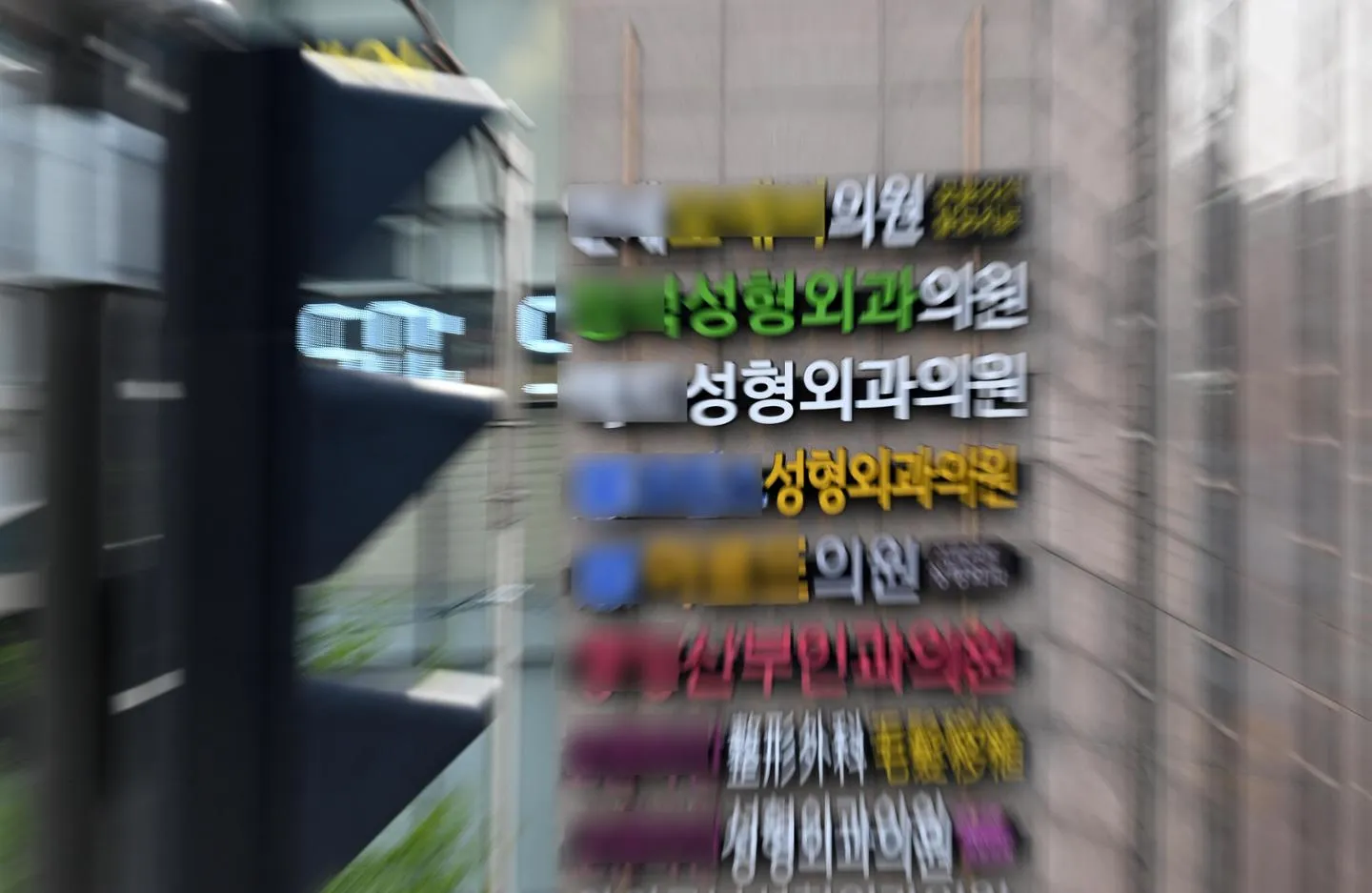
Signboards. A specialist's clinic is normally named in the form "[Name] Plastic Surgery Clinic" (○○성형외과의원), with the specialty in the clinic name itself. A GP's clinic is normally "[Name] Clinic" (○○의원) with the words "Treatment subject: plastic surgery" (진료과목 성형외과) added separately. The same distinction shows up in legal commentary on Korean clinic naming: GPs should generally be named "○○의원" and may list a treatment subject in that "진료과목" format.
Bios. A real bio says the doctor completed a plastic surgery residency at a named hospital, or obtained the plastic surgery specialist qualification. If a bio says only "specialist" with no field, the association says to assume it's a specialist in a different field.
Look-alike societies. The association warns about similar-sounding bodies such as the Korean Aesthetic Surgery Society or international "beauty" societies, and about titles such as "aesthetic surgery specialist." Those aren't plastic surgery specialist qualifications. In one Seoul Central District Court case reported by the Korean Medical Association's newspaper, a GP who advertised as an "international cosmetic plastic surgery specialist" was fined. The court said the title was only a course completion certificate used as if it were a licence.
Certificates and ID badges. A genuine specialist certificate is issued in the name of the Minister of Health and Welfare, lists the person's name and resident registration number, and shows plastic surgery as the category. Since November 2014 the association has also asked specialists who belong to the relevant societies to wear an ID badge. Foreign visitors can't verify a resident registration number, so use the certificate as supporting evidence, not as your only check.
Stickers. The association and the society issue stickers for clinics with specialists. But a clinic can display one when only one of several doctors is a specialist. Treat it as a hint about the clinic and ask about the individual.

The new association mark, and the signboard rule that isn't here yet
On 10 May 2026 the association unveiled a new specialist mark: a shield with a smile. It added the English words "Plastic Surgeon" so foreign patients can recognise it. The association's president said the mark reflects how hard it is for patients to find specialists. The association also claims that among doctors who advertise plastic surgery, roughly 90 percent are non-specialists and 10 percent are specialists. That's the association's own estimate, reported in May 2026, and it has an interest in the message, so treat it as an estimate.
The government has said it will tighten signboards. Reports in June 2026 said the Ministry of Health and Welfare planned to ban non-specialist clinics from showing a specialty such as plastic surgery on their signboards. In a June 2026 Hankook Ilbo report on signboards, the change was expected around the end of 2026 and would apply only to newly opened or relocated clinics. Window decals, banners and interior ads would stay outside the rule. I couldn't confirm that it has taken effect as of 17 November 2026, so don't rely on it. Even after it does, the change will cover only the signboard. Window film saying "plastic surgery" can still sit above a GP clinic.
Separately, a bill filed on 9 November 2026 would require clinics to state at the reception desk and consulting-room door whether the doctor is a specialist or a GP. It's a bill, not law.
Verify the clinic, then verify who holds the scalpel
Clinics that treat foreign patients must register with their metropolitan or provincial government. Korea.net's guide to hospitals serving foreign patients says registration requires specialist physicians in each medical department and malpractice insurance that covers foreign patients. It's valid for three years. The list of registered institutions is searchable by region on the Medical Korea site.
Check it, because it filters out unregistered operations. But it's a facility check. It says a clinic has some specialists and some insurance. It says nothing about whether the specialist is the one operating on you, which is the question that actually matters.
That brings up the problem Korea has already legislated against: proxy or "ghost" surgery, where someone other than the agreed surgeon operates. Since 25 September 2023, operating rooms must have CCTV when a patient is under general or sleep anaesthesia and the patient or guardian asks for recording. Footage must be kept for at least 30 days, and violations can bring fines of up to 5 million won (about US$3,500). The rule came out of the 2016 death of a patient during facial contouring surgery at a Gangnam clinic. It has exceptions, and clinics can decline in some circumstances, so don't treat CCTV as a guarantee. Ask the clinic in writing, before you pay a deposit, whether recording is available.

Questions to send before you book
Put these in an email so there's a written answer. Plain wording works.
- What is the full name, in Hangul and in English, of the surgeon who will operate?
- Is that person a plastic surgery specialist (성형외과 전문의)? At which hospital was the residency, and in what year was the specialist qualification granted?
- Will that same surgeon do the consultation, the operation and the follow-up visits?
- Who administers the anaesthesia, and what is their qualification?
- Is the clinic registered for foreign patients, and what is the registration number?
- Does the consent form show the operating surgeon's name, and can I see it before I arrive?
If the clinic answers with a coordinator's script and avoids naming a person, take that as information. A board-certified plastic surgeon in Korea usually has no reason to hide their name.
What a specialist certificate does not tell you
Certification shows that a surgeon completed a defined training route and passed an exam. It doesn't tell you how often they perform your procedure, what their complication rate is, or whether the result will match what you want. No result is guaranteed, and revision surgery is a real possibility with any surgeon. A cosmetic procedure also carries risks of infection, bleeding, asymmetry, scarring and anaesthesia complications.
A reasonable order of operations is to verify the surgeon first, then ask about their experience with your specific procedure, then compare plans. Consult a board-certified plastic surgeon in Korea in person, or by video if that's offered, before deciding. That consultation is where you can ask about risks and recovery for your own face or body, which no directory can answer.
Frequently asked questions
Can any doctor in Korea legally perform cosmetic surgery?
Yes. Any licensed physician in Korea may legally perform cosmetic procedures. Only a doctor who finished a four-year plastic surgery residency after a one-year internship, passed the national specialist exam and was recognised by the Minister of Health and Welfare may use the title plastic surgery specialist (seonghyeong oegwa jeonmunui). A clinic with 'plastic surgery' in its marketing is not proof of that training.
What is the official way to look up a plastic surgeon's specialist status in Korea?
The Korean Society of Plastic and Reconstructive Surgeons runs a public specialist directory on plasticsurgery.or.kr, listing 2,881 Ministry of Health and Welfare-recognised plastic surgery specialists as of March 2026. Search by the surgeon's Korean name. Because it lists active society members, a missing name is a reason to ask more questions, not final proof. Cross-check with the Korean Association of Plastic Surgeons list.
Does a plastic surgery sticker or logo on the door prove my surgeon is a specialist?
No. Stickers certified by the two plastic surgery bodies can be displayed when only one of several doctors at a clinic is a specialist. The sticker tells you someone there may be qualified, not that this person will operate on you. Ask the doctor directly, ask for the name in writing, and look that exact name up in the directory.
Is a clinic registered for foreign patients the same as a board-certified surgeon?
No. Registration with the local government for treating foreign patients checks the institution: it requires specialist physicians in each department and malpractice insurance covering foreign patients, and it lasts three years. It does not tell you who will operate on you or what that person's qualification is. Verify the facility on the Medical Korea site, then verify the surgeon separately.
What should I do if the surgeon is not on the specialist list?
Ask the clinic for the surgeon's full Korean name, residency hospital and specialist certificate number, then search again, since spelling variants cause misses. Check the association's directory and the clinic's HIRA page. If the surgeon still cannot be confirmed as a plastic surgery specialist, treat the clinic as non-specialist and decide on that basis, or choose another. The association also takes impersonation reports.
This article is general information, not medical advice. Results, risks and costs vary from person to person. Talk to a board-certified plastic surgeon before making any decision about surgery.